在铜基超导体中直接观察到Zhang-Rice单态和电子库珀对的形成
(Visualization of the Zhang–Rice singlet, electronic molecules and Cooper pair formation in a cuprate superconductor)
S. S. Ye, J. F. Zhao, Z. H. Yao, S. X. Chen, R. Z. Yu, Z. H. Dong, Z. Q. Hao, X. T. Li, L. C. Shi, Q. Q. Liu, C. Q. Jin, and Y. Y. Wang
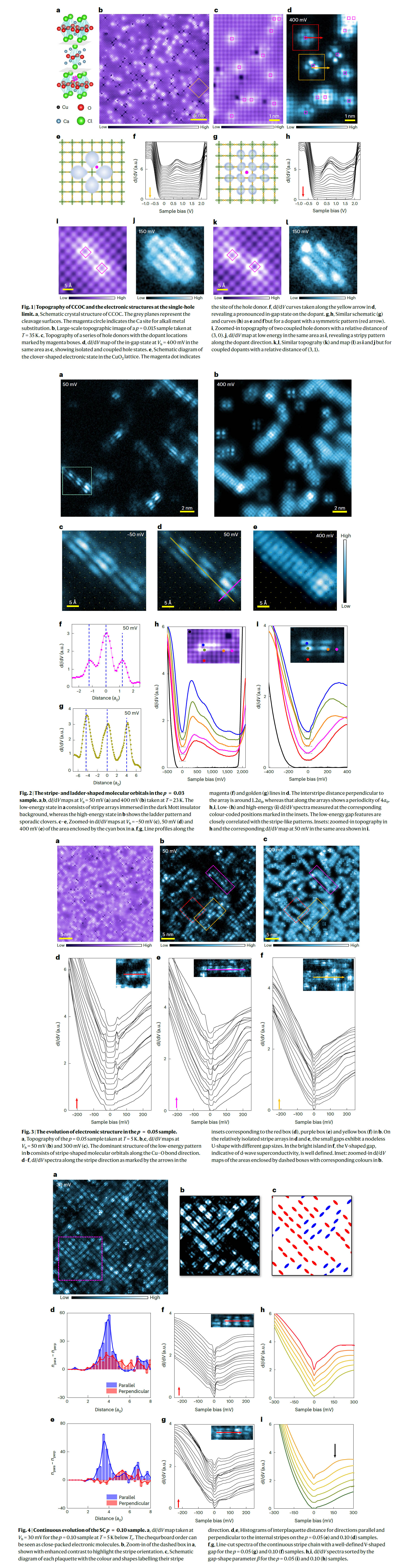
High-temperature superconductivity in cuprates can be realized by doping holes into an antiferromagnetic insulator. To understand the mechanism by which this happens, one must elucidate the electronic state of a single doped hole and the coupling between them that gradually leads to pairing. Experimental progress has been hindered by the technical challenges in probing the electronic properties of a small number of holes dispersed into an insulating oxide. Here we show that in Ca2CuO2Cl2 with dilute hole doping, an isolated dopant exhibits an in-gap electronic state with a spatial pattern consistent with a localized Zhang–Rice singlet. The dopant forms a bound state with a hole in a copper orbital. With increasing hole density, the overlap of Zhang–Rice singlets generates rod-shaped patterns. These electronic molecules spontaneously segregate into plaquettes with a lateral size of approximately four lattice constants. Our spectroscopic-imaging scanning tunnelling microscopy shows that the first indication of pairing is a U-shaped energy gap that emerges in the electronic molecules. It evolves smoothly into a sharp V-shaped gap characteristic of d-wave superconductivity in extended islands of electronic molecules. These results provide insights into the emergence of Cooper pairing in cuprates.